
Design Principles
Convention Over Configuration
Section titled “Convention Over Configuration”goctl scaffolding and standard folders reduce team-level divergence and improve collaboration efficiency. Every engineer working on a go-zero project finds the same layout:
internal/handler/ ← HTTP binding onlyinternal/logic/ ← business logic onlyinternal/svc/ ← shared dependenciesinternal/model/ ← data access onlyWhen the layout is non-negotiable, code reviews focus on substance rather than style.
Stability by Default
Section titled “Stability by Default”Resilience mechanisms are built in as framework capabilities, not optional add-ons. Circuit breaking, rate limiting, load shedding, and timeout control activate automatically with zero configuration:
// This single line is protected by:// - P2C load balancing// - circuit breaker (Google SRE style)// - per-RPC deadline from ctx// - Prometheus metrics// - OpenTelemetry spanresp, err := l.svcCtx.OrderRpc.CreateOrder(l.ctx, req)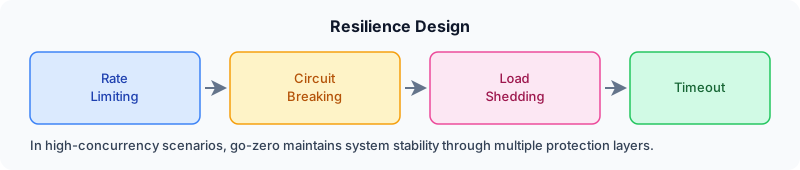
Clear Responsibility Boundaries
Section titled “Clear Responsibility Boundaries”Handlers, logic modules, service context, and models are intentionally separated to reduce coupling:
// handler — only decodes request and calls logicfunc (h *CreateOrderHandler) ServeHTTP(w http.ResponseWriter, r *http.Request) {    var req types.CreateOrderReq    if err := httpx.Parse(r, &req); err != nil {        httpx.ErrorCtx(r.Context(), w, err)        return    }    l := logic.NewCreateOrderLogic(r.Context(), h.svcCtx)    resp, err := l.CreateOrder(&req)    httpx.OkJsonCtx(r.Context(), w, resp)}
// logic — only implements business rulesfunc (l *CreateOrderLogic) CreateOrder(req *types.CreateOrderReq) (*types.CreateOrderResp, error) {    // validate, call model, call downstream RPC    order, err := l.svcCtx.OrderModel.Insert(l.ctx, &model.Order{        UserId:  req.UserId,        Product: req.Product,    })    if err != nil {        return nil, err    }    return &types.CreateOrderResp{OrderId: order.Id}, nil}
This boundary is enforced by code generation — goctl never puts business logic in handlers.
Observability-first Execution
Section titled “Observability-first Execution”Production-grade systems need logs, metrics, and traces from day one, not after incidents happen. go-zero injects all three into every request automatically:
// logx writes trace_id + span_id into every log line automaticallylogx.Infow("order created", logx.Field("orderId", id))// JSON output: {"level":"info","trace_id":"4bf92f35...","span_id":"00f067aa","orderId":"ord_123"}
// Prometheus counter incremented per request/response code — no code needed// go_zero_http_server_requests_total{method="POST",path="/order",code="200"}
Enable distributed tracing by adding four lines to etc/user-api.yaml:
Telemetry: Name: user-api Endpoint: localhost:4317 Sampler: 1.0